One Piece card variants are different collectible printings of the same underlying card. They can share a set code and card number—and usually the same game text—while using different artwork, foil treatment, stamp or rarity treatment. That is why searching only OP13-118 can return a RM60 card and another reference-priced above RM80,000.
For Malaysian collectors, the safest way to identify a card is to use its set code + card number + exact treatment. Do not assume two cards are the same because the character name and number match. Compare the artwork, printed finish and variant label before using any RM price or adding the card to a collection.
The same Luffy card, five very different variants
Monkey.D.Luffy OP13-118 from Carrying On His Will is a clear example. Stacked Binder currently catalogues five distinct collectibles under that base card number. The images below are publisher-supplied catalogue images, so the visible SAMPLE overlay is expected.
| Foil | Alt Art | Wanted Poster | Manga Alt Art | Red Manga Alt Art |
|---|---|---|---|---|
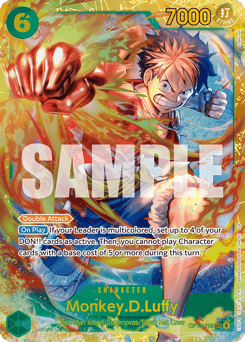 |
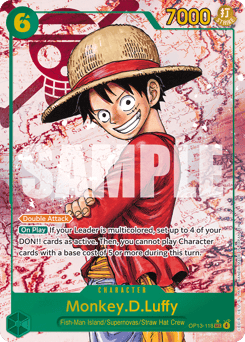 |
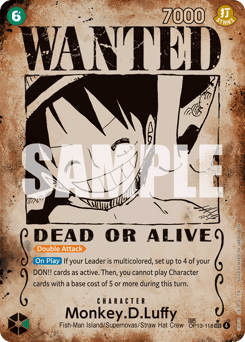 |
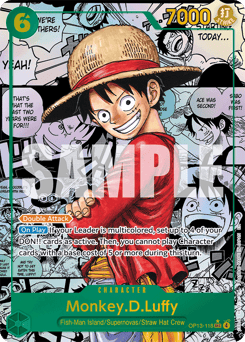 |
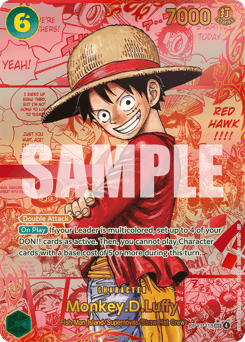 |
| RM60.51 | RM332.95 | RM1,339.05 | RM8,520.75 | RM80,515.97 |
Those figures are not five valuations of one interchangeable card. They are five separate catalogue entries. The wide range reflects the market reference attached to each treatment, not a promise that a Malaysian buyer will pay that amount.
Variant and rarity do not mean the same thing
A rarity is the card's printed rarity class, such as Common, Rare, Leader or Secret Rare. A variant is a distinct treatment or printing of that card. OP13-118 is a Secret Rare at its base, but it also appears in Foil, Alt Art, Wanted Poster, Manga Alt Art and Red Manga Alt Art versions.
The distinction matters because the broad rarity tells you where the card sits in the product's rarity system; the variant tells you which collectible object is in front of you. Price, availability and collector demand can differ sharply between parallel versions even when their playable text is identical.
When checking a listing, ask two separate questions:
- What is the base card? Read the code and number, such as
OP13-118. - Which printing is it? Match the artwork and treatment to the exact catalogue entry.
How to read a One Piece card code
In OP13-118, OP13 identifies the main booster set and 118 identifies the card within that set. Other prefixes can identify starter decks, promotional cards or other product families. The official One Piece Card Game card list is the primary place to confirm official card names, codes and product groupings.
A suffix used inside a database or image URL—such as the A, B, C and D attached to the Luffy examples above—is a catalogue distinction between treatments. It may not be printed beside the card number on the physical card. Use it as a search and database identifier, then verify the card visually.
Searching the full code is usually faster than searching a character name alone. A name such as Luffy appears across many sets and promotional releases; OP13-118 narrows the results to one base card and its parallels.
Common One Piece variant labels
Variant names are catalogue labels, not a universal promise about pull rates or value. These are the families Malaysian collectors are likely to see on Stacked Binder:
- Normal or Foil: the standard artwork and its listed finish. Foil does not automatically mean the most valuable printing.
- Alt Art: a parallel with different artwork or presentation. It remains tied to the same base card number.
- Manga or Red Manga Alt Art: premium parallel treatments using manga-style artwork. Red Manga is recorded separately when the catalogue identifies it as its own collectible.
- Wanted Poster: artwork styled around the series' wanted posters, again saved as a separate variant.
- SP, stamped and promotional versions: special printings tied to a product, event, anniversary, prize or stamp. The exact label and image matter more than guessing from the character name.
- Serialized cards: individually numbered limited printings. If the serial number affects the collectible, a general ungraded reference may not describe a particular copy adequately.
Not every card has every treatment, and labels can evolve as new products are released. Treat the image and full catalogue record as the source of identity rather than trying to infer a variant from price alone.
Why do the catalogue images say SAMPLE?
The SAMPLE text is part of the publisher-supplied One Piece catalogue imagery used by the data source. It appears across ordinary cards as well as premium variants. Seeing it on a Stacked Binder image does not mean the physical card is fake, and it is not a watermark added by a seller.
For an actual card offered in Malaysia, inspect original photographs rather than relying on a catalogue image. Check the front, back, corners, surface and any condition notes. A catalogue picture can identify the intended printing, but it cannot prove that a seller owns the card or show the condition of the copy being sold.
How the RM reference price works
Stacked Binder stores a market reference for each exact collectible and converts the source currency using the matching MYR exchange-rate snapshot. The date matters: the table above is a snapshot from 29 August 2026, and later refreshes may show different figures.
The result is a consistent reference for comparing variants, not an appraisal or a record of completed Malaysian sales. A local selling price can differ because of condition, availability, seller reputation, platform fees, postage and the number of real buyers at that level. Read the site's pricing methodology and data notes before treating a high reference price as cash value.
A useful comparison always keeps the identity fixed: same game, set, number and treatment. Comparing the Foil price of OP13-118 with a Red Manga listing is not evidence that one seller is cheap; it is comparing different collectibles.
Saving variants and completing a set
Your collection saves the exact collectible variant you add. If you own both the Foil and Alt Art versions, add each one separately so the card list and RM total do not substitute one price for another.
A set checklist answers a different question: how many base cards from the printed set do I own? For now, one checklist tick represents one base card number. Reverse treatments, parallels and other variants do not each require a separate tick. This keeps set completion simple while the collection remains the precise record of which versions and quantities you own.
Browse the One Piece set catalogue, open a set and choose Start checklist if you want a completion view. Use the + action or the card page when you want to record the exact version in your collection.
Common questions
Why can the same One Piece card number have several prices?
Because the number identifies the base card, while different artwork, foil, stamp or premium treatments are separate collectibles. Match the exact variant before comparing prices.
Does SAMPLE on a One Piece card image mean the card is fake?
No. SAMPLE appears on the publisher-supplied catalogue images used for One Piece cards. For a card being sold, ask for original photographs to verify the actual copy and its condition.
Does a set checklist need every parallel variant?
No. The current checklist uses one tick per base card in the set. Save Foil, Alt Art, Manga and other exact variants separately in your collection.
Are these actual Malaysian sale prices?
No. They are source-market references converted to MYR using the matching exchange-rate snapshot. They are useful benchmarks, not completed Malaysian sales, offers or condition-adjusted valuations.
Should I search codes such as OP13-118?
Yes. The full set code and number usually gives a cleaner result than a character name. Then use the artwork and variant label to choose the exact printing.
Check the exact printing
Start with the One Piece set catalogue, search the printed code, and open the card whose artwork and treatment match the copy in front of you. The code finds the family; the image and variant label identify the collectible.
Catalogue and price observations checked 29 August 2026. Prices are reference figures, can change after publication, and are not an offer to buy or sell.