The approximate cost to complete a Pokémon or One Piece set is the sum of current RM references for the checklist cards you have not ticked as owned. Stacked Binder calculates it from your personal missing list, so two collectors working on the same set can see different totals.
It is a useful scope estimate—not a promise that every missing card can be bought in Malaysia for that amount.
The calculation
The checklist starts with every eligible catalogue card in one set. For each card:
- owned cards are excluded;
- missing cards with a current price contribute their latest MYR reference;
- missing cards without a usable price remain in the missing count; and
- only the priced missing cards are summed.
In compact form:
Estimated cost to complete = sum of current MYR references for priced missing cards
If you are missing 78 cards, 72 have prices and those references total RM1,240, the interface says Missing 78 · ≈ RM1,240 across 72 priced cards. It does not pretend the other six cost RM0.
Three possible messages
| Coverage | Example wording | Meaning |
|---|---|---|
| Every missing card priced | Missing 78 · ≈ RM1,240 to complete | The sum covers all 78 missing catalogue cards. |
| Some missing cards priced | Missing 78 · ≈ RM1,240 across 72 priced cards | Six missing cards are excluded from the money total. |
| No missing cards priced | Missing 78 · cost unavailable | Progress is known, but a defensible total is not. |
That coverage language is more important than a false-precision total. A number without its priced-card denominator can understate a set whose difficult cards have no current feed value.
Why your actual spending can be different
The estimate does not automatically include:
- near-mint versus played condition;
- grading premiums or authentication costs;
- Malaysian postage, platform fees and seller margin;
- bundle discounts, trades or cards pulled from sealed product;
- the cheapest available finish when one catalogue card has several market variants; or
- whether a high reference has enough buyers and completed transactions behind it.
For that reason, treat it as the current reference value of the missing project, not a guaranteed checkout basket. The pricing methodology explains the source-market and same-day MYR conversion used throughout the site.
The biggest missing cards matter most
Completion percentages and completion costs answer different questions. A binder can be 95% complete while the final 5% represents most of the remaining value. Conversely, a set can have many inexpensive missing cards and a modest cost despite a low percentage.
Use the Missing filter to identify which cards dominate the amount. For a set such as Pitch Black, a few illustration and hyper-rare cards can outweigh a long list of low-priced base cards.
| Higher-value missing example | Lower-value missing example |
|---|---|
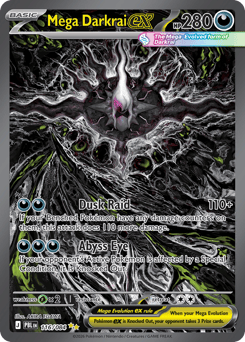 Mega Darkrai ex #116 |
 Misty's Vitality #111 |
The images are identity examples, not a claim that either price will remain fixed. Open each card to see its latest dated reference.
Use the estimate to choose a project
Before committing to another set:
- start its checklist;
- tick the cards already in your binders;
- compare missing count with priced coverage;
- inspect the most expensive missing cards; and
- decide whether your definition includes extra parallels beyond the checklist.
This is more useful than comparing set totals with zero ownership. The right question is not “what is the whole catalogue worth?” but “what remains after the cards I already own?”
Pokémon and One Piece use the same logic
The formula is game-neutral. What differs is catalogue structure. Pokémon can hold market variants such as normal, holofoil and reverse holofoil under one card identity; One Piece frequently represents named collectible treatments as separate catalogue cards. In both cases, the set checklist follows eligible base entries and the exact collection preserves the detailed version you own.
Use the Pokémon sets index or One Piece sets index to start with a set you already collect, then open Collections to compare active checklists.
Common questions
Are unpriced cards counted as free?
No. They remain in the missing count and are excluded from the RM sum; partial coverage is stated explicitly.
Is cost to complete the cheapest possible buying cost?
No. It is a sum of current catalogue references, not a live cart optimized for condition, finish, seller or postage.
Why did my estimate fall after ticking one card?
That card left the missing set, so its current reference no longer contributes to the remaining total.
Why can the amount change when I tick nothing?
Daily market references and exchange rates can change, causing the same missing list to produce a different dated estimate.
Does 100% mean every parallel is owned?
No. It means every eligible catalogue card in that checklist is ticked. A personal master-set definition may include additional variants recorded in the exact-card collection. Calculation and interface wording checked 29 August 2026. All amounts are references, not offers to buy or sell.